Wednesday, May 30, 2007

Lightning Bugs

May 30 at 10pm - The lightning bugs have made their first appearance of the year tonight. Dozens (perhaps hundreds) of them are flashing and blinking on the hillside in my backyard. I like lightning bugs...

Tuesday, May 29, 2007

Leading in Iowa: John Edwards

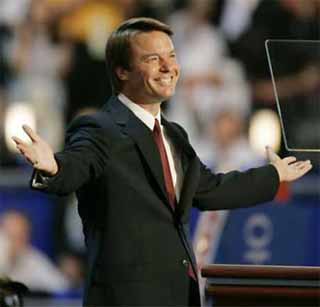
John Edwards is the Democratic Party's frontrunner in Iowa, according to a recent poll by the Des Moines Sunday Register. A win in Iowa could move Edwards up in the polls nationally. But the Iowa Caucuses are still about eight months away.

At the moment, 29% of likely voters in Iowa would vote for Edwards. Illinois Sen. Barack Obama is second with 23% and Hillary Clinton is in third place with 21% of the vote.

Memorial Day Weekend

We had a nice Memorial Day.

Friday we ate at the famous Big Daddy's restaurant on Rt. 16 near Adria, Va. Cheryl had a cheeseburger (their proprietor, Punky, oversees the making of the best cheeseburgers in Tazewell County, and possibly in Southwest Virginia). I ate country fried steak and gravy from their bar, with corn, cabbage, and fried potatoes.

After Big Daddy's we went home and took a nap before watching a couple of hours of television.

I spent much of Saturday writing for China Venture News. I did sneak in a nap. We had Ritz Cracker Fried Chicken for dinner with mashed potatoes and peas. After dinner we drove out to Cavitts Creek Park and started to walk around Lake Witten. It rained, so we quit early and went home. We watched the Carquest Auto Parts 300 and went to bed.

Sunday was a monumental day, the turning point of the year: it was the day I carried the air condition up from the basement to out second floor bedroom and put it in the window. No more birdsongs to wake up to in the mornings...

We made it all the way around Lake Witten on Sunday afternoon. It was a pleasant walk. We got a close up look at a grouse, a large muskrat, a fish that must have been 18 inches long in the dark water of the lake, hordes of dragon flies that were a nice shade of baby blue, a turtle, honeysuckle, various ducks, a black snake, and a few other animals.

We had pizza for dinner (Little Caesar’s, purchased from the Anawalt Elementary School PTO) and watched the Coca-Cola 600. I was glad to see J.J. do so well, but I'm really tired of Hendrick Motor Sports winning all the races.

Monday we drove into Bluefield and ate lunch at Quiznos. I had the new Baja Chicken sandwich (with fresh cilantro). Cheryl had a beef dip. Afterwards we dropped back out to the lake and spent an hour in a paddle boat. I made taco salad for dinner.

Tuesday morning, back to work...

Monday, May 28, 2007

The Future of Cursive

(Note: I am a member of the International Reading Association - the IRA. Throughout this blog you will find the ideas of professionals from the IRA's listserv interspersed in maroon in the text. Please also take a moment to take my poll on this topic.)

I am a sick man. Well, maybe not as sick as the Underground Man in Dostoevsky's book. But my handwriting is pretty sick. Bad things happen when I write in cursive...


There are reasons for it, I suppose.

My problem with "demanding cursive"
from children is precisely that it
is a demand. We put enough hurdles along the
course already. Several are unnecessary, although
rather high.
- Hugo Kerr, From
the International Reading Association's
Listserv


I like to give out the excuse that all of my fingers have been broken, many of them twice (which is true). But I was 14 or so when I broke them all the first time at a roller rink (my hands got run over by someone much bigger than me), and I think my penmanship was pretty awful already then. Probably it's my mother's fault; she should have beaten me for bringing home "D's" in penmanship in elementary school and, probably, I would have done better...

To be honest
I think cursive doesn't really
serve a purpose except for signing
things.... Everything we read that is
published is in regular print
so why do we demand students
write in cursive?
- Kate Rose, From
the International Reading Association's
Listserv


Cursive has an interesting history in English. The Brits, I believe, call it "joined up writing." The word "cursive" is used for a flowing script style in a number of languages - not all of which use Roman letters.

When William Bradford penned the Mayflower Compact in 1620, most of his letters were disconnected. But they did look much like our current lettering.


Some one hundred and fifty years later, Thomas Jefferson's hand written rough draft of the Declaration of Independence showed most words as connected in a single flowing line. The signature of John Hancock still had a few breaks between letters within it.

President Lincoln's handwriting looked little different than cursive script does today.

In the 1960's a handful of academic publishers (like Zaner-Bloser and D'Nealian) made efforts to codify and simplify cursive. The effect was probably the opposite of what was intended; competing handwriting curriculums resulted in greater variation in handwriting in America.

That, so far, is a summary of Wikipedia's page on cursive. And if this were an academic article (instead of my personal blog) I'd feel compelled to cite them as a source.

It is much easier for me to
write in cursive. I work with dyslexic children. Some
do much better with cursive; others need
to print. Thankfully, my tool
is now a computer and find that with this
population computers work best.
- Diann LaRosa, From
the International Reading Association's
Listserv


The thing I found most interesting was the changing nature of cursive, the very fact that our style and manner of writing has progressed and changed over time. The question, of course, is one of whether the time has come for more profound change.


If handwriting were intended as an art form that our culture really valued for its aesthetics, I'd be more supportive of it. Writing is an art form; but the art is literary, not visual. The art resides in the smithing of phrases and the choice of verbs and adjectives from a metaphorical palate that includes a rage of colors allowing for phrases ranging from pastel understatements like "his physical appearance lacked a certain degree of appeal" to full color hyperboles like "Bob owned hound dogs that were more handsome than he was." Certainly the lines must be legible to be meaningful; but as long as they are legible, it matters little whether they are written laboriously in fountain penned calligraphy or typed in MS Word in Edwardian Script ITC font. Both can be perfumed if inked on the right paper...

How much do we use cursive in the real
world. I for one combine printing and cursive
with a pattern long established but one I'm not
sure others could pick up on.
- Cathy P. Miller, From
the International Reading Association's
Listserv


In March of 2004 the American Federal of Teachers published an article entitled Is teaching cursive writing a waste of time?. Two teachers face off on the issue. The first argues that cursive no longer serves a purpose and should go the way of eight track tapes. The second says we will always need handwriting (but fails to explain why we can't just print) and that children need to learn to write cursive because they need to be able to read cursive. Her argument deteriorates into the aesthetic value of cursive (I don't think society places that much value on the aesthetics of actual writing anymore, though it places great value on layout and graphic design). And her concluding punch is that kids who can write well in cursive make her job easier because she can read their papers. I thought, "have the type or print them..."


I haven't used cursive since
high school, and I have been out for over 20
years now. I went back to print writing in
my junior year of high
school... Cursive should become like calligraphy,
a nice extra.
- Karyn Zmuda, From
the International Reading Association's
Listserv


CBS News has a rather dour story archived online from 2003. Penmanship: A Dying Art? almost bemoans the demise of penmanship and at times seems to belittle communication by email. That's as good a sign as any I'd say that penmanship really is a dying art.

I would agree that we, as adults, rarely
use cursive anymore. Most of us tend
to print. It does need to be taught however. There
are many things that are
written in cursive, past and present. With
the many fonts to choose from on the computer
as well, it is important for everyone to be able to
read and write in
cursive.
- Heidi Strander, From
the International Reading Association's
Listserv


I suppose the thing that bothers me the most in all of this is that the discussion seems to be confined to the way we write - that is to say, to the way we move our hands when we put pen to paper. I don't think that is the real issue. While I agree that a handwritten note is more sentimental, I think that computers have made it easier to preserve our thought (and the words that go with them). In the information age, the percentage of our writing that has some personal sentiment attached to it (the kind that requires lavender colored stationary with little flowers on the edge) has declined considerably.

I guess I'm in a minority. I learned
to write both ways, but prefer to
write in cursive. I can write faster that way, and it
seems like I make fewer mistakes. Logically, it seems
like cursive would be faster since the
letters flow together.
- Priscilla Boersma, From
the International Reading Association's
Listserv


The keyboard has changed the way I think. It has made my ideas more malleable. It has made writing a greater part of the process of developing my thoughts. With a pen in my hand and paper before me I write the beginning first, the middle second, and the end last. I begin with an outline of my thoughts and resist the urge to rearrange my ideas because that means starting over, with a fresh leaf of paper. But after years of working on a keyboard I often write the middle first and the beginning last, rearranging my thoughts repeatedly as I go. Paragraph four may actually end up as paragraph two; and when I'm done I can change then beginning or the end without starting over.

I'm old enough to remember
THE DAYS BEFORE COMPUTERS. We had to write
our papers in script, because that was the
professional, adult thing to do. A few
of us took typing lessons, but it wasn't required
in high school. That changed in college,
of course. So: maybe the schools need to keep up
with the times. Computers are
here to stay!
- Beth Forrester, From
the International Reading Association's
Listserv


meIf the truth becomes clearer as I dwell on it, I can change what I'm saying before I publish it. That may not be impossible with a Bic, but it can be taxing. The keyboard has taken me from being a deductive writer (who starts with an unwavering conclusion to express) to being an inductive writer who uses the process of writing to manipulate his ideas and find his conclusions.

Does the keyboard change the way my students think? Definitely. Incredibly. Is that good? I suppose that depends on the user. Students have to decide whether the keyboard helps them do more or helps them be lazy. Teachers have to identify cognitive skills that handwriting promoted (like thinking ahead) and find ways to promote those skills without the need to have a pencil in the student's hand.

Whether it's good or bad, the keyboard is here and it is not going away...

Sunday, May 27, 2007

Ritz Cracker Fried Chicken

I get a magazine from Kraft about once a month with recipes in it. The most recent one had an excellent recipe for fried chicken breast. It starts with a boneless, skinless chicken breast. The recipe calls for a mixture of crushed Ritz crackers, dried basil, and Parmesan cheese. I keep Parmesan–Romano-Asiago mix in the fridge and used that instead of straight Parmesan. Thaw the breast, rinse it in cold water, and dredge it in the cracker mixture. Then fry it in a non-stick skillet on medium in oil - about four minutes on each side. Do not cover it.

I've used the recipe twice. The second time I used an Italian herb mix instead of straight basil and I added nutmeg. Both times the chicken has come out great. It a nice quick-and-easy recipe...

Tuesday, May 22, 2007

Election 2008 and the Evangelical Dilemma

The Christian Right (Religious Right, whatever you want to call them) faces a dilemma at the moment and I'm not sure they even see it...

In 1979 when Rev. Jerry Lamon Falwell, Sr. founded the Moral Majority, the Christian Right in America entered a golden era of political influence. Leaders like Falwell, Pat Robertson, and James Dobson (to name just a few) wanted to bring America back to God, and wanted government to reflect the values of the Bible.

The most heated issue on the Evangelical plate is abortion. Sure, they're against gay marriage, have strong views on educational issues (like prayer in school, vouchers, the teaching of evolution, etc), and want to see God incorporated more into government with things like the posting of the Ten Commandments in courthouses. But abortion is THE issue.
The dilemma they have is that Democrats (like me) all belong to a party that supports a woman's "right" to choose to have an abortion. That's the consensus of the Democratic Party. there are individual party members (like me) who don't believe in abortion; but the Party does. So the Religious Right can't support a Democrat. But none of the Republicans this go around are particularly interested in religion. Economics, yes; religion, no. Except for one: Mitt Romney.

I said that I don't think the Christian Right see their dilemma. What I mean is that the Christian Right thinks that their dilemma is that they don't have a really good candidate to support. Rudy Giuliani is leading in most of the national polls among GOP candidates. But he's not very strong on abortion (and he's been divorced umpteen times). I think their dilemma is that they could end up embracing Romney as a candidate. Romney is leading at the moment in Iowa and New Hampshire; if he wins those races he could gain a lot of momentum...

Don't misunderstand me. This is analytical, not emotional. I don't have a problem with Mormons. But if the idea originally was to take America back to God, the Christian Right ought to be skeptical about the whether a Mormon doing that. Why? Without making this a profoundly theological discussion,
  • Christians (especially members of the Christian Right) believe that Jesus Christ was God Incarnate (made into a human being); Mormons don't.
  • Christian believe that Jesus died to rescue us from a hopeless bondage to sin; Mormons don't. Mormons believe he came to live a good life, teach, and set an example for us to follow.
  • Christians believe that we get to Heaven by having faith in Jesus and trusting in the fact that he died for our sins; Mormons believe that we get to Heaven by being good (an error that half the books in the New Testament, particularly Galatians and Hebrews, were written to refute).


Mormons aren't Christians. Mormons find this statement offensive. Unapologetically, I regret that. But in years (centuries) past those who believed as Romney does would have been called heretics.

The dilemma for the Christian Right? Do they embrace a heretic who is against gay marriage and shares a few other political goals with them, or do they embrace someone they disagree with but who at least pays lip service to the fundamental truths of Christianity, or do they stay home on election day?

The irony, if they end up endorsing Romney, is that he's not that strong on abortion...

Monday, May 21, 2007

Writing Online

I write. I have for as long as I can remember.

I understand there's a correlation between hypergraphia and Temporal Lobe Epilepsy (TLE). I have TLE, but it is controlled (I haven't had a seizure in 15 or 16 years); and I think I love to write before I had my first seizure at 14. Fyodor Dostoevsky is supposed to have had hypergraphia, so that's not bad company to be in. But I don't think my own drive to write can be described as "an overwhelming urge." I just like to write...

The Internet provides a lot of opportunities to write. Some of them pay money. Years ago I wrote for Suite 101 about Appalachia. I think they paid me something like $15 a month for a minimum of two articles each month. I later wrote for the Suite about special education issues on a couple of occasions and every once in a while I get a few dollars from them in my paypal account for stuff that's still online.

In 1999 I went to work for About Dot Com. About was more intensive. They paid a minimum that changed from time to time. But the goal was to attract enough traffic to be paid "by the hit," or visitor. I spent eight years with About - first as the "guide for Southeast Asia for Visitors (part of their Travel Channel) and later covering the continent of Asia as a whole - Turkey to Indonesia, Tokyo to Tel Aviv. About had a payment model that included growth incentives after the New York Times Company bought them in 2004 (I think, maybe 2005). I made $7,000 or $8,000 as a minimum per year writing from my living room in my spare time for them. There were years when I made closer to $12K and a particular year when I made $20K.

Guess I'll make that third pot after all...


The trouble About Dot Com was keeping up. In 1999 the goal was to present other people's content, to point readers to things we'd found online and "pre-surfed" for them. Over time the emphasis changed to creating our own content. Then links away from our sites began to be discouraged. In 1999 we had to FTP our files after we'd written the HTML (the computer language that makes pages look the way they do on the Internet) ourselves. Over the years About developed tools (kind of like forms) that we used instead. Then the tools would change and some content would have to be reworked, reformatted. A great deal of time got spent changing stuff we'd already written just to keep in looking right - oh, and learning to use new tools. Then came the image gallery tool and the emphasis on pictures. This year the focus began to shift to video formats. The New York Times Company doesn't want you to have to read as much, so maybe video will take over in the future. (What's a hypergraphic to do?) My relationship with About came to an end a few weeks ago after eight year (which is, like, 56 years in Internet time). I outlived a huge number of people there. It's been something of a relief...

At the moment I write for Creative Weblogging. Their page on venture capital investment in China is a fun gig and pays okay - about $6 a blog post for me. The potential is there to make a couple of thousand a year. China Venture News is the site...

Not so profitable is Helium. I have seven articles online at Helium. All of them are technical articles about education. I've made seven cents at Helium in the eight days they've had my stuff. When you've earned $25 they pay out to your Paypal account. So at the current rate I'll get my first check in 2014. One downside: they ask for all rights forever to anything you submit. That might be okay for technical articles (I can always right something else about 504 Plans or Down syndrome); but for creative work it sucks.

Of course, if you just want to see your name on the Internet, there are plenty of sites on politics and the like where you can post comments. Raising Kaine is an example of one here I've posted recently.

I'll probably fid other opportunities to write online. And this isn't an exhaustive list of stuff I've done. But you get the idea...

Sunday, May 20, 2007

The Tomatoes Are Out

Lemon Boy TomatoThe tomatoes are out. I put them out today - 14 this year. That's not as many plants as last year but it will probably do for us.

I know what you're thinking if you don't live around here: "You waited until May 20th to put your tomatoes out?" Well, it was 33°F here Friday morning. We've had frost as late as May 31st at our house. I almost put them out last weekend. Maybe they would have lived through the cold...

Yellow Pear TomatoI was pleased this year to find an heirloom tomato called "yellow pear" on sale locally. I put some out a couple of years ago and they were great - nice taste, and the plant produced quarts and quarts of the little thumb-sized things. They have a nice taste and they dress a baby spinach salad up very nicely. I put out two plants.

Mr. Stripey - the Hillbilly TomatoI put our three Mr. Stripey tomato plants. Mr. Stripeys are irregular in shape and two-toned. They grow to be fairly large and look beautiful sliced on a plate. But last year they all blighted and I'm not sure we ate a single one of them. Maybe we'll have better luck this year. I put out three plants.

Early Girl TomatoesOf course I put out some Early Girl plants as well. Early Girl tomatoes turn very red and come to maturity in about 60 days. We'll probably be eating a few of them by mid-July. I have three of them.
What's left? Three Lemon Boy plants (yeller tomatoes taste the best), a Pink Beefsteak, and two Big Boy hybrids.

Here's wishing for a good growing year and the first frost of Fall to hold off until late October of November...

Thursday, May 17, 2007

Abbey's Birthday

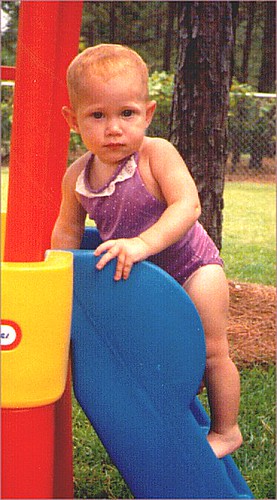
Abbey in Grandma Connie's backyard sometime before her second birthdayWhen Abbey was young she was inquisitive. We lived in Canberra, Australia, for almost four years; and because my epilepsy prevented me from getting a driver's license back then, we went many places on a bicycle together. I peddled while she sat in the kiddy seat and asked questions. Question after question after question...
Daddy, why is the sky blue?

I know there's some answer to that - something about how molecules in the air scatter blue light from the sun more than they scatter red light. That's a lot to say when you're peddling up hill with a forty pound passenger on your bike.

It's just that way, sweetie.

Well, why doesn't it rain more here?

Because most of Australia is desert and the air here is pretty dry...

I worked to suck more air in so that I could talk while I peddled.

Well then why doesn't it rain less?

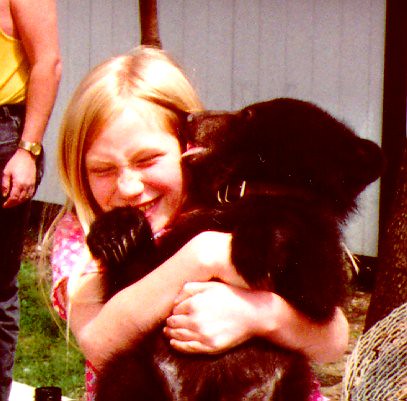
Abbey at a petting zone near Tazewell, about 1998I'm sure there had to be some good reason for that, too.

Well, uh...

Does powdered milk come from powdered cows?

I was still working on "rain less" in my head.

Not quite, I said. We’d had a lot of powdered milk when we'd lived in the Pacific and the girls used to wrinkle their noses up and ask if it was "real" milk. I'd tell them it certainly wasn't imaginary...

Is all grass the same color green?

I knew the answer to this one and I liked "yes" or "no" questions when I was the one peddling.

Abbey on the phone, by her sister HannahNo, I said. Grass comes in lots of different shades of green.

She was quiet for a moment, like she was considering the implications of that botanical fact. I waited for a follow up question. At the age of four Abbey was a pretty sharp child, probably because she was so inquisitive...

Why can't I go to school yet?

Hmmm. No follow up.

Hannah goes to school. Why can't I go to school?

Your sister is older than you, I said. You get to go to school with her next year.

We arrived at our destination. The Youth With A Mission facility in Canberra, where I worked, had a large courtyard; there were other kids Abbey's age whose parents were there for short term training of some kind or other. I unbuckled her from the bicycle seat and she ran off with one of them to play...


It seems like such a long time ago. Abbey's not a little girl anymore. She still asks simple-but-hard questions and often doesn't like the answers she gets.

On May 20th this week Abbey turns 20. If you read this, Abbey, happy birthday. Cheryl and I love you...

Tuesday, May 15, 2007

My Favorite Isogloss

I love languages. Linguistics, the study of how language works (not some particular language but all language) is one of my favorite topics.

I don't know when it started. In high school I took Latin and German (my father was stationed in Germany in the Army and we lived in Stuttgart). In college I dabbled in New Testament-era Greek. In grad school I took a year of Malay and did linguistic work with native speakers of Lugandan (an African langauge) and Finnish. And in my travels I've learned a few words of Thai, Chamorro, Chinese, Korean, French, Japanese, Tamil, Italian, Hawaiian, Tagalog, Ponepean, Russian, Arabic, and... You get the idea.

An isogloss is a geographic area that is characterized by some linguistic feature. The feature could be phonetic - like the area of the U.S. Atlantic seaboard where local people pronounce the name on one of the states as "nu joy-zee." But my favorite isoglosses have to do with vocabulary - with the words we use.

There's a line my wife and I drive across pretty regularly and when we drive across that line we leave one isogloss and cross into another. It's in West Virginia on US Rt 19. Going north, after you leave Fayetteville, you pass Smales Branch. It's the last "branch" you see. Then shortly after you leave Summersville you come to Spruce Run, and then Bear Run.

As a boy growing up I knew what a "branch" was in reference to a flowing body of water. Springs come out of the ground and, flowing away from their source turn into branches, which then grow to be creeks and eventually are promoted to rivers. We didn't have runs where I grew up. One effect of that was that I always wondered about the name of that great Civil War battle, Bull Run. I could picture the Confederates in gray and the Union boys in blue - and the bulls, running. I figured they probably interfered a lot with the battle. It's hard to concentrate on shooting when you know a bull might step on you at any time.

We've made the drive from the Bluefield, Va. area to the panhandle of Maryland many times. When I first commented on that line we crossed, my sweet wife thought that it was funny (as in puzzling or peculiar) that I thought the line was interesting. She grew up where there were runs and knew that at Bull Run all the soldiers had to cope with was a trickle of water, not bulls.

Oh well, for now at least: my favorite isogloss is that line that seems to divide people's vocabulary regarding flowing water into runs or branches...